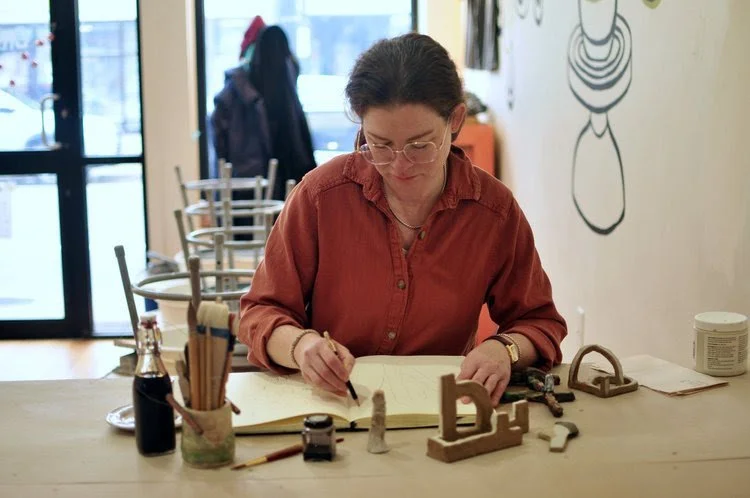
Meg Rotzel working in the ceramic studio, photo by Evelyn Jackson
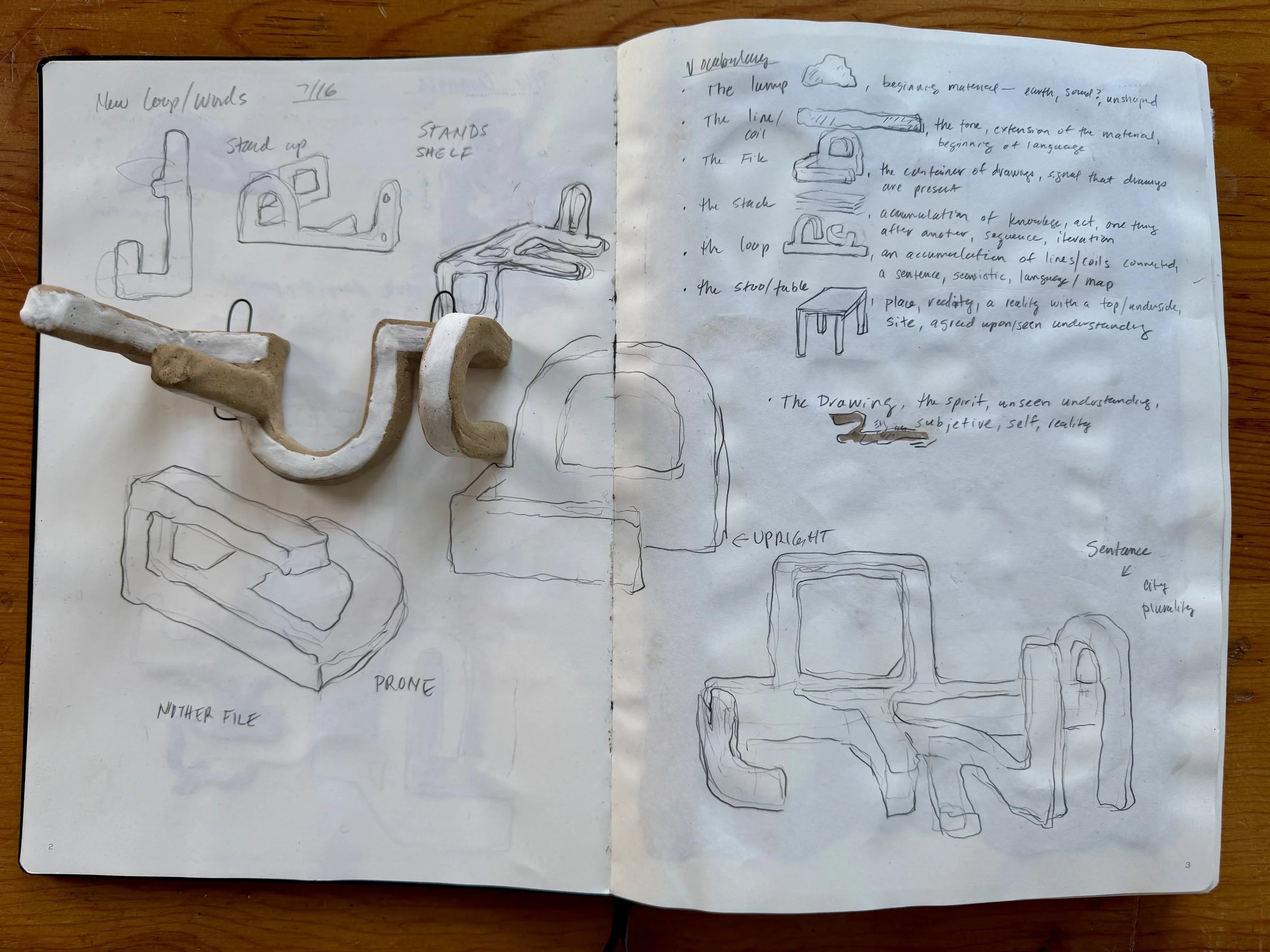
Meg Rotzel’s studio notebook with clay sketch
Artist Profile
By Emma Green
Meg Rotzel came to clay at a tender time. Her first time at the Roslindale clay studio, Create, was just a few weeks before a scheduled brain surgery. When she was in recovery, still grasping to orient herself, she took a walk around the neighborhood and found herself back at Create. “My brain was totally reorganized, and I couldn’t recognize things,” she said. “But Gena took me by the hand, and reoriented me and gave me a pile of clay. And for the last two years, I have just been alive in that practice.”
During those early forays into clay, Meg was navigating the ways her mind felt different following her surgery. It was hard to access structured modes of thinking. At times the connections between images and words felt hazy and out of reach. The physicality of clay was a way for her to connect with thinking differently. “The material itself was generative,” she said. “Thinking with my brain was hard. Thinking with my body was not hard. I came into an understanding that my mind was distributed throughout my body.” Even when it felt like her thinking mind didn’t know what to do, her body did.
Much of Meg’s artistic practice centers on drawing. Her sketchbook is full of sinuous lines, calligraphic shapes formed through the patient motion of a brush and ink. Since coming to the ceramic studio, those lines have clattered off the page in the form of coils, formed into shapes that mimic those of her drawings. “The connection to drawing is the line. [With] the coil, I thought, I am manifesting the line with my hands out of this material that is so close to earth. My hand and whatever else it’s connected to had a material representation in a new way.”
Clay sculptures have also become framing devices for her drawings, and the clay objects she creates have found their way back into her drawings, a process of repeated translation: take a drawing, reproduce it in clay, then make a drawing of that. There is a searching here, a wandering, a repetition, like returning to the same landscape day after day to see how it transforms.
The symbols of language, that slippery abstraction, become physical: an idea is translated into a word, a word is broken down into syllables, the syllables are rendered as letters, the letters are abstracted into drawings, the drawings become physical objects made of mud, mud that has been made solid and permanent. Something slippery becomes something that can be grasped and molded. “Sometimes I had symptoms of aphasia, other times it was just too much work to have a conversation or think of words. Somehow, that experience brought out these letter forms, and reminded me and informed me of how a written language or calligraphy is a human move,” Meg said. “We want to and have to draw our sounds, draw our words.” Often it is not until we are estranged or alienated from something – especially something as daily as language – that we can truly look at it.
This studio, and this material, have changed Meg’s artistic practice. For Meg, materials themselves are generative: they make demands of us, they engage us in practices of repetition, they ask us to encounter them and to hone our technique. Clay has brought a new set of demands into her way of making. “Being in the community, learning from others, and working with something that is so elemental has changed my practice,” she said.
Emma Green, Writer, VT Digger
2026